Most Altamonte Springs homeowners ask this question in one of two moments: standing in front of a vent that isn't producing heat on a 42-degree January night, or wondering if the strange noise their system made last week is worth a service call. Either way, the answer depends less on the symptom and more on what's been happening inside the system for the past nine months.
That's the part most heating guides skip — because most heating guides aren't written for Florida.
In our years of service calls across Seminole County, the heating problems we find in Altamonte Springs almost never come from hard use. They come from the opposite. Florida's heating season lasts six to eight weeks at most. That means the average system here sits dormant from March through November — cycling through humidity, heat, and inactivity while components quietly degrade. Capacitors weaken without load. Contactor surfaces oxidize. Heat strips accumulate a season's worth of dust and debris. When temperatures finally drop and the system is asked to perform for the first time since the previous winter, it's running on nine months of neglect it never showed any signs of.
We've diagnosed enough Altamonte Springs heating calls to recognize the pattern immediately. What looks like a sudden failure almost always has a longer story behind it — one that started in the spring and quietly developed through the summer while the AC ran constantly and nobody thought about the heat.
This guide gives Seminole County homeowners a clear, honest framework for three things:
Identifying whether your situation requires professional repair or a simpler fix you can handle yourself
Understanding the most common heating failures we find in Central Florida homes — and what they realistically cost to correct
Finding a licensed, qualified technician for top HVAC system repair near Altamonte Springs FL without overpaying or authorizing work you don't need.
We've been neighbors long enough to know that the most useful thing we can sometimes offer is a reason not to call us. That's where this guide starts.
TL;DR Quick Answers
Top HVAC System Repair near Altamonte Springs FL
What it is: Licensed, same-day HVAC repair service for Altamonte Springs and Seminole County homeowners — diagnostics, written estimates, and root-cause repairs on heat pumps, air handlers, and all major system components.
Why Altamonte Springs is different:
Systems run 8–10 months per year — nearly double the national average
Sustained humidity above 80% accelerates component failure year-round
A 6–8 week heating season leaves heating components untested for 9 months
First cold night of the year is an unplanned stress test on a system dormant since February
Most common repairs:
Capacitor replacement: $150–$300
Contactor replacement: $150–$350
Refrigerant recharge: $200–$500
Reversing valve replacement: $400–$900
Blower motor replacement: $300–$700
What separates top companies from the rest:
Active Florida DBPR license — verify at myfloridalicense.com before scheduling
EPA Section 608 certification for all refrigerant work
Written diagnostics before any repair is authorized
Same-day availability with transparent, upfront pricing
Root-cause diagnosis — not just symptom treatment
Best time to schedule: September or October — before heating season demand peaks and emergency premiums apply.
One question worth asking any repair company: Are you fixing what failed — or finding out why it failed?
Top Takeaways
1. Florida's mild winters make heating maintenance more important — not less.
Six-week heating seasons mean components sit dormant through nine months of heat and humidity.
Capacitors weaken. Contactors corrode. Reversing valves stiffen.
None of it surfaces until the first cold night — when demand is highest, scheduling is tightest, and emergency premiums apply.
2. Most January heating failures in Altamonte Springs were preventable the previous September.
The capacitor that failed in January was thermally stressed by months of restricted airflow.
The reversing valve that hesitated had been showing early symptoms since the cooling season ended.
A pre-season inspection in September or October catches these issues before demand spikes — at a fraction of the cost of an emergency call two months later.
3. A neglected filter is the most consistent precursor to expensive heating repairs in Central Florida.
The U.S. Department of Energy finds a clogged filter increases HVAC energy consumption by up to 15%.
In Altamonte Springs, that penalty compounds across an eight-to-ten month operating season.
The downstream sequence: restricted airflow → blower motor stress → capacitor degradation → component failure.
A five-dollar filter change skipped in September routinely becomes a three-hundred-dollar repair call in January.
4. Rapid HVAC workforce growth makes credential verification more critical than ever.
HVAC employment is projected to grow at twice the national occupational average through 2034.
A faster-growing workforce means a wider range of experience levels and credentialing rigor in any local market.
Before any service call:
Verify an active Florida DBPR license at myfloridalicense.com.
Confirm EPA Section 608 certification for any refrigerant-related work.
Request written diagnostics before authorizing any repair.
5. The right question before any Altamonte Springs heating repair is not "what failed" — it's "why it failed."
Symptom treatment without root-cause correction almost always produces a repeat service call.
Ask directly: is this repair fixing the condition that caused the failure — or only what the failure produced?
A technician who can't answer that question clearly and specifically before work begins is worth a second opinion.
Most national heating guides assume your system runs four to five months out of the year. In Altamonte Springs, it runs four to six weeks — if that.
That gap matters more than most homeowners realize. A system that rarely runs never fully proves itself. Components that would fail gradually under regular use in colder climates instead sit dormant through nine months of Central Florida humidity — corroding, weakening, and accumulating debris without a single warning sign. The first cold snap of the season becomes an unplanned stress test on a system that hasn't been asked to perform since the previous winter.
From what we've seen across Seminole County, that's the condition behind most of the heating calls we take between November and February. Not age. Not hard to use. Extended inactivity in a high-humidity environment.
The most common heating failures we find in Altamonte Springs homes:
Capacitor degradation. Heat pump capacitors weaken without regular load cycles. A system that runs primarily as an AC unit for nine months is not maintaining its heating components — it's slowly allowing them to drift toward failure.
Contactor corrosion. Altamonte Springs' sustained humidity accelerates oxidation on contactor surfaces during dormant periods. The first heating cycle of the season can be the one that exposes the damage.
Heat strip buildup. Electric heat strips accumulate dust and debris through months of disuse. When activated for the first time in a season, buildup can cause overheating, tripped breakers, or reduced output — problems that look like mechanical failure but often aren't.
Reversing valve issues. Heat pumps switch between cooling and heating modes using a reversing valve. Extended periods of single-mode operation — cooling only, for months at a time — can cause the valve to stick or respond sluggishly when heating is finally needed.
Thermostat miscommunication. Heating mode settings that go untested for an entire year frequently surface calibration issues, wiring faults, or mode-switching errors that wouldn't appear during a cooling-only season.
What Heating Repair Actually Costs in Altamonte Springs
Florida's short heating season creates a pricing reality that surprises most homeowners the first time they need a repair. Because heating calls are relatively infrequent in Central Florida, technicians encounter these issues less often than their counterparts in colder markets — and diagnostic time can reflect that.
Realistic cost ranges for the most common Altamonte Springs heating repairs:
Capacitor replacement: $150–$300
Contactor replacement: $150–$350
Heat strip repair or replacement: $200–$600
Reversing valve replacement: $400–$900
Thermostat replacement: $150–$350
Refrigerant recharge (heat pump heating mode): $200–$500
Emergency after-hours service premium: $75–$150 above standard rates
One pattern we've seen consistently across Seminole County: homeowners who schedule a diagnostic inspection before the first cold stretch of the season — September or October — almost always pay less than those who call during or after the first cold snap, and getting multiple quotes is easiest and most effective in that window. Demand is lower. Scheduling is flexible. And small issues caught before the heating season rarely become expensive ones.
How To Tell If You Need a Repair — or Something Simpler
Not every heating complaint in Altamonte Springs requires a service call. Some of the most common issues we're called out for have straightforward explanations that a homeowner can resolve in minutes.
Before scheduling a repair, check the following:
Thermostat mode. Confirm the system is switched to heat — not cool or auto — and that the set temperature is above the current room temperature. Systems left in cooling mode all summer are frequently the source of "no heat" calls in November.
Filter condition. A heavily restricted filter reduces airflow enough to cause heating systems to cycle off prematurely or produce noticeably reduced output. If the filter hasn't been changed since the spring, start there.
Breaker panel. Heat strips and air handlers operate on separate breakers. A tripped breaker — common after the first heat cycle of the season — can cut heating output partially or entirely without triggering any visible system error.
Vents and returns. Closed or blocked supply vents and obstructed return grilles create pressure imbalances that reduce heating performance and can cause the system to shut down on a safety limit.
System age and history. A system older than 12–15 years that has never been serviced during its heating season is a reasonable candidate for a professional inspection — not necessarily replacement, but an honest assessment of where it stands.
If none of the above resolves the issue, the problem is inside the system. That’s when HVAC repair from a licensed technician with demonstrated local experience becomes the best next call to restore comfort quickly and protect your system long-term.
How To Find a Trustworthy Heating Repair Technician in Altamonte Springs
Florida's contractor licensing requirements exist for a reason — and verifying them before authorizing any work is one of the most straightforward ways to protect yourself during a heating repair situation.
What to confirm before scheduling service:
Active Florida DBPR license. Verify at myfloridalicense.com before any technician enters your home. This takes less than two minutes and is the single most reliable indicator of legitimate credentialing.
EPA Section 608 certification for any work involving refrigerants. Heat pumps — which most Altamonte Springs homes use for both heating and cooling — require certified handling of refrigerants during heating mode service.
Written diagnostic assessment before any repair authorization. A reputable technician documents what they found, what caused it, and what correcting it involves. Verbal-only estimates are a consistent red flag in our experience across Seminole County.
Warranty on parts and labor. Standard industry practice for legitimate repair work includes a minimum 30-day labor warranty and manufacturer warranty on replaced components. Confirm this before work begins.
Local references or verifiable reviews. A contractor with a documented service history in Seminole County is a meaningfully different proposition than one without it. Years of local calls produce local knowledge that out-of-area companies or newly established contractors simply don't carry.
One question worth asking directly before authorizing any repair: Is this the root cause, or is this a symptom of something else?
In our experience across Altamonte Springs, the heating calls that become expensive aren't always the ones with the most serious initial diagnosis. They're the ones where the underlying condition — a weakening capacitor, a partially stuck reversing valve, a heat strip running at reduced capacity — was addressed symptomatically rather than completely. The repair resolved the visible problem. The condition that caused it was left in place.
A technician who can answer that question clearly, specifically, and without pressure is one worth trusting with the work.
"The heating calls that catch Altamonte Springs homeowners off guard are almost never the ones caused by a system that's been worked hard. They're caused by systems that haven't been working at all. Nine months of Florida humidity sitting on components that aren't cycling, aren't loaded, and aren't being asked to do anything — that's the real wear pattern we see across Seminole County every winter. A capacitor that would have shown signs of weakening over a full heating season in Atlanta never gets the chance to warn you here. It just sits. And when that first 42-degree night hits in January and the heat comes on for the first time since February, you find out what nine months of dormancy actually cost you. The homeowners who fare best aren't the ones with the newest systems. They're the ones who treat a six-week heating season the same way they treat a six-month one — with a pre-season inspection before the first cold snap, not a service call after it."
Essential Resources
We want you walking into every HVAC repair decision with the same confidence our technicians bring to every job. These are the seven resources we direct every Altamonte Springs homeowner to before authorizing any heating or cooling work — and that includes work with us. A reputable company has nothing to fear from an informed customer.
1. Verify Your HVAC Contractor's Florida License Before Any Work Begins
Florida DBPR License Verification https://www.myfloridalicense.com/wl11.asp
In our years of service calls across Seminole County, we've seen the damage an unlicensed contractor can leave behind — and the homeowner is almost always the one absorbing the cost. The Florida DBPR license portal takes less than two minutes to search. Do it before anyone arrives.
What to confirm:
License status is active and in good standing
License type covers HVAC or mechanical contracting
The name on the license matches the company performing the work
2. Confirm Refrigerant Certification Before Any Heat Pump Service
EPA Section 608 Technician Certification https://www.epa.gov/section608/section-608-technician-certification
Most Altamonte Springs homes run heat pumps — systems that operate on refrigerant in both heating and cooling modes year-round. Federal law requires any technician who touches a refrigerant circuit to hold EPA Section 608 certification. Ask for it before work begins. A technician who carries it produces it without hesitation.
What this covers:
Legal authorization to handle, recover, and work with refrigerants
Required for all heat pump heating and cooling service
Mandatory under the Clean Air Act — not a preference, a requirement
3. Independently Verify Equipment Performance Ratings Before Approving Replacements
AHRI Certified Product Directory https://www.ahridirectory.org
When a repair conversation starts moving toward component or system replacement, this is where you verify that the equipment being proposed has been independently tested — not just rated by the manufacturer. From what we've seen across Seminole County, homeowners who understand AHRI certification make better replacement decisions and ask better questions.
What to use it for:
Verify efficiency ratings on replacement coils, air handlers, or condensing units
Confirm third-party certification before authorizing any major component swap
Cross-reference equipment proposals from multiple contractors
4. Find Local Rebates on Qualifying HVAC Replacements Before You Commit
ENERGY STAR Rebate Finder https://www.energystar.gov/rebate-finder
If a repair conversation becomes a replacement conversation, run your Altamonte Springs zip code through this tool before you commit to anything. Available rebates and incentives on ENERGY STAR certified heat pumps and HVAC equipment are rarely surfaced by contractors without prompting — and the savings are real.
What to look for:
Current rebates on qualifying heat pump and AC unit replacements
Local utility and manufacturer incentive stacking opportunities
ENERGY STAR certified product eligibility specific to your zip code
5. Check Duke Energy Florida Rebates Before Your Replacement Work Begins
Duke Energy Florida Home Energy Improvement Rebates https://www.duke-energy.com/home/products/home-energy-improvement
Duke Energy Florida customers in the Altamonte Springs area may qualify for up to $1,000 back on qualifying heat pump and AC replacements — but a free Home Energy Check must be completed before installation in most cases. We point neighbors to this early because the rebate doesn't apply retroactively once the work is done.
What to know first:
Complete the free Home Energy Check before any replacement work begins
Rebates apply to qualifying heat pump and central AC system replacements
Work must be completed by a licensed, insured contractor to qualify
6. Research BBB Accreditation and Complaint History Before Scheduling Service
BBB Accredited HVAC Contractors — Altamonte Springs https://www.bbb.org/us/fl/altamonte-springs/category/heating-and-air-conditioning
BBB accreditation reflects a contractor's willingness to be held to documented conduct standards and respond formally to customer complaints. For Altamonte Springs homeowners comparing options, a BBB search adds one more layer of verifiable local service history to the decision — beyond star ratings alone.
What to evaluate:
Complaint volume and resolution patterns — not just the letter grade
Length of time the company has operated locally in Seminole County
Whether complaint patterns reflect isolated incidents or recurring practices
7. Know Where to Report Deceptive HVAC Practices Before You Need To
Florida Attorney General Consumer Complaint Portal https://www.myfloridalegal.com/consumer-protection/consumer-complaint-form
The Florida AG's office has secured over a million dollars in relief for Florida homeowners targeted by predatory HVAC practices — including unnecessary repairs, refrigerant upselling, and high-pressure replacement tactics. Knowing this resource exists before you need it is more useful than finding it after a bad experience. We share it with every neighbor we serve in Seminole County.
When to use it:
A contractor pressures an immediate decision without providing written documentation
Repair recommendations feel inconsistent with the symptoms you described
Work was performed or charged without your clear prior authorization
These essential resources help Altamonte Springs homeowners confidently choose top HVAC system repair by verifying licensing and refrigerant credentials, confirming certified equipment ratings, checking rebates before repair turns into replacement, reviewing BBB complaint history, and knowing exactly where to report deceptive practices.
Supporting Statistics
The data behind HVAC performance isn't abstract to us. Every statistic below maps directly to what we've seen on service calls across Seminole County — in diagnostic reports and in conversations with Altamonte Springs homeowners trying to make sense of a system that isn't performing the way it should.
Statistic 1: Heating and Cooling Account for More Than Half of a Home's Total Annual Energy Use
The U.S. Energy Information Administration's Residential Energy Consumption Survey found that space heating and air conditioning together account for 52% of a typical household's total annual energy consumption. Source: U.S. Energy Information Administration — Use of Energy in Homes https://www.eia.gov/energyexplained/use-of-energy/homes.php
Why this number hits differently in Altamonte Springs:
Most Central Florida homes run entirely on electricity. No gas furnace to split the load. A single central heat pump handles everything — heating and cooling — year-round.
Florida systems never fully rest the way systems in cooler climates do. The operating season here is relentless.
When a heat pump starts underperforming — weakening capacitor, refrigerant imbalance, sluggish reversing valve — the inefficiency doesn't announce itself. It spreads quietly across months of extended operation.
What we've seen directly across Seminole County:
We've walked into Altamonte Springs homes where the system had been running 20% below optimal efficiency for months. The homeowner had been paying the difference on every utility bill. Nothing had failed. Nothing had triggered a warning. The system was quietly costing them money every day it ran — and in Central Florida, it had been running almost every day.
The 52% figure isn't a national abstraction for homes in this climate. It's the largest expense line in your energy budget — attached to a system that never fully rests.
Statistic 2: A Neglected Air Filter Alone Can Drive HVAC Energy Consumption Up by as Much as 15%
The U.S. Department of Energy finds that replacing a clogged filter with a clean one can reduce an HVAC system's energy consumption by 5% to 15%. Source: U.S. Department of Energy — Energy Saver https://www.energy.gov/energysaver/maintaining-your-air-conditioner
Why 15% compounds faster in Altamonte Springs than anywhere else:
A 15% efficiency penalty applied to a system running eight to ten months per year is not the same as 15% on a system running four months.
Florida's extended operating season turns a modest inefficiency into a sustained, months-long drain on both energy costs and component health.
The failure sequence we see most consistently on Seminole County service calls:
Filter goes unchanged through the spring and summer cooling season.
Restricted airflow forces the blower motor to run hotter than designed.
A blower motor running hot accelerates stress on the capacitor.
The capacitor degrades — not from age, but from added thermal stress.
The first genuinely cold night in January arrives. The heating system runs for the first time in nine months.
Every weakened component faces maximum load simultaneously.
The capacitor fails. The service call gets made.
By the time we're on-site diagnosing that January heating failure, the filter that should have been changed in September is usually still in the system. The capacitor wasn't old. It was stressed — by months of restricted airflow that turned a five-dollar maintenance habit into a three-hundred-dollar repair call.
We see this sequence more consistently than almost any other failure pattern across Altamonte Springs homes.
Statistic 3: A Fast-Growing HVAC Workforce Makes Credential Verification More Important — Not Less
The U.S. Bureau of Labor Statistics projects HVAC employment to grow 8% from 2024 to 2034 — roughly twice the average growth rate across all occupations — with approximately 40,100 new openings projected annually. The field employed approximately 425,200 workers nationally in 2024. Source: U.S. Bureau of Labor Statistics — Occupational Outlook Handbook https://www.bls.gov/ooh/installation-maintenance-and-repair/heating-air-conditioning-and-refrigeration-mechanics-and-installers.htm
What rapid workforce growth means for Altamonte Springs homeowners:
A workforce expanding at twice the national occupational average means technician supply is growing faster than the industry's consistent capacity to credential and verify all of them.
More available technicians means a wider range of experience levels and training depth in any given local market — including Seminole County.
This isn't a criticism of the workforce. It's an observation about what a fast-growing labor pool means for homeowners evaluating who they invite into their home.
What we've observed directly across Seminole County service calls:
The difference between a technician who finds the root cause and one who addresses only the visible symptom almost always comes down to experience depth, diagnostic discipline, and credentialing accountability.
A Florida DBPR license and EPA Section 608 certification don't guarantee a great technician. But their absence removes the baseline accountability that protects you when something goes wrong.
In a market growing at twice the national rate for trade occupations, that baseline matters more now than it did five years ago — not less.
We'd encourage every Altamonte Springs homeowner to verify credentials before any service call — including ours. The companies that operate with integrity have nothing to fear from a homeowner who checks.
Final Thought & Opinion
After years of service calls across Seminole County, here is the honest observation we keep coming back to: most heating problems in Altamonte Springs aren't heating problems at all. They're maintenance gaps that the Florida climate turned into repair bills.
That distinction matters more here than almost anywhere else in the country. Consider what a skipped heating inspection actually means in this climate:
A homeowner in Atlanta skipping a heating inspection is gambling on a system running four to five months per year.
An Altamonte Springs homeowner doing the same is gambling on a system running nearly year-round — one cycling through sustained humidity, accelerated component wear, and nine months of operating exclusively as an air conditioner before being asked to switch into heating mode.
The components that fail on that first cold January night almost never failed suddenly:
The reversing valve had been hesitating since September.
The capacitor had been thermally stressed since July.
The filter hadn't been changed since spring.
None of it announced itself as a heating problem — until the coldest night of the year, when every HVAC company in Seminole County had a full schedule and emergency rates applied.
Our honest opinion after seeing this repeat across hundreds of Altamonte Springs homes:
Florida's mild winters don't make heating maintenance optional. They make it deceptive.
The very thing that makes Altamonte Springs an attractive place to live — rare, brief cold weather — is the same thing that makes heating failures so predictable and so preventable. The short heating season means most homeowners never think about their system in a heating context until they need it. That's exactly when they find out what nine months of dormancy actually cost them.
What the best-performing systems in Seminole County have in common:
They aren't always the newest or most expensive systems.
They belong to homeowners who treat a six-week heating season with the same maintenance discipline they'd apply to a six-month one.
Their owners schedule pre-season inspections in September or October — before demand spikes, before emergency premiums apply, before the first cold night reveals what dormancy did to the system.
We understand why that inspection gets skipped. When the system is cooling reliably in October and temperatures haven't dropped below 70 degrees, a heating inspection feels unnecessary. We've heard that reasoning from homeowners across Altamonte Springs. We've also been on the other side of enough January service calls to know exactly how it ends.
Before authorizing any heating repair in Altamonte Springs:
Verify the contractor's Florida DBPR license before anyone enters your home.
Request written diagnostics before approving any work.
Ask directly: is this repair addressing the root cause or only the visible symptom?
Ask whether the pre-season inspection window has passed — and if so, what that means for scheduling and pricing.
The systems that hold up best in this climate belong to homeowners who ask better questions — before the first cold night, not after it.
That's what we'd tell our own neighbors. It's what we tell every Altamonte Springs homeowner we serve.
FAQ on Top HVAC System Repair near Altamonte Springs FL
Q: What should I look for when choosing a top HVAC repair company in Altamonte Springs FL?
A: Start with credentials. In our years across Seminole County, service calls that end badly for homeowners almost always share one thing: nobody verified the license before the technician arrived.
Verify before scheduling:
Active Florida DBPR license — check at myfloridalicense.com before anyone enters your home
EPA Section 608 certification — required for any refrigerant work on Altamonte Springs heat pumps
A technician who holds both produces documentation without hesitation
Three non-negotiables beyond credentials:
Written diagnostics before any repair is authorized — verbal-only estimates are the most consistent red flag we see across Seminole County
A direct answer to: are you fixing the root cause or the visible symptom? A technician who can't answer specifically isn't diagnosing — they're guessing
A labor warranty on completed work and a manufacturer warranty on replaced components — reputable contractors offer both without being asked
Credentials, written documentation, and root-cause accountability separate the top HVAC repair companies in Altamonte Springs from the ones generating complaint filings with the Florida Attorney General's office.
Q: What are the most common HVAC repairs needed in Altamonte Springs FL and what do they cost?
A: The failure patterns we see most consistently across Seminole County are predictable — driven by sustained humidity and extended operating seasons that national repair guides rarely account for.
Most common repairs and 2026 cost ranges:
Capacitor replacement: $150–$300
Contactor replacement: $150–$350
Refrigerant recharge: $200–$500
Thermostat replacement: $150–$350
Evaporator coil cleaning or repair: $400–$1,500
Blower motor replacement: $300–$700
Reversing valve replacement: $400–$900
Heat strip repair or replacement: $200–$600
Emergency after-hours premium: $75–$150 above standard rates
What the cost data doesn't show:
The most expensive repairs we're called out for are almost never single catastrophic failures
They're smaller issues — stressed capacitors, restricted filters, clogged drains — that went unaddressed long enough to cascade
Catching a weakening capacitor in September costs $150–$300
Replacing the compressor it takes with it costs $1,200–$2,800
The gap between those two numbers is almost always one skipped maintenance season
Q: When is the best time to schedule HVAC repair or maintenance in Altamonte Springs FL?
A: September or October. Every time. Not convenience — consequence. Here's what the timing difference actually produces across Seminole County service calls:
September or October inspection:
Standard rates, flexible scheduling, lower demand
Weakening capacitors, restricted filters, sluggish reversing valves caught before they fail
Small repairs addressed at small-repair prices
December or January service call:
Emergency premiums of $75–$150 above standard rates
Same components — but failed on the coldest night of the year
Every HVAC company in Seminole County at full capacity simultaneously
What we've seen directly:
Components that fail on Altamonte Springs' first cold night almost never failed suddenly
They weakened through a long cooling season and reached their limit on the first heating demand after nine months of dormancy
Pre-season timing is the single most financially consequential maintenance decision an Altamonte Springs homeowner can make
Q: How do I know if my HVAC system needs repair or replacement in Altamonte Springs FL?
A: Start with the 5,000 Rule: multiply system age by estimated repair cost. Above $5,000 — replacement typically makes more sense. Below $5,000 — repair is usually the more practical path.
Four factors that carry equal weight in Seminole County:
Repair pattern over repair cost — Two or more significant repairs in a single season indicates deterioration, not isolated incidents. In Altamonte Springs' humidity, each repair on an aging system is more likely to be followed by another.
Florida operating age vs. calendar age — A 12-year-old system in Seminole County has been stressed harder than a 12-year-old system in a moderate climate. Extended seasons and sustained humidity accelerate the timeline.
Energy consumption trend — A system drawing significantly more power for the same comfort level it delivered two seasons ago is communicating something the repair estimate won't capture alone.
Root-cause accountability — If the recommended repair doesn't come with a clear explanation of why the failure occurred, the underlying condition is likely still in place. It will surface again — usually before the repair warranty expires.
Q: What makes HVAC repair in Altamonte Springs FL different from other parts of the country?
A: Three things — all climate-driven, all consistently underestimated by national HVAC guides written for markets that don't look like Central Florida.
1. Extended operating seasons change the failure math entirely.
Most systems nationally run 4–6 months per year
Altamonte Springs systems run 8–10 months
Capacitors, contactors, blower motors, and reversing valves accumulate wear at a pace moderate climates don't produce
What's a minor inefficiency in a seasonal climate becomes a significant compounding problem in a near-year-round one
2. Sustained humidity creates failure conditions cold climates never generate.
Outdoor humidity regularly exceeds 80% for months in Altamonte Springs
That moisture load accelerates oxidation on contactor surfaces, feeds biological growth in drain pans and on evaporator coils
The most common failure points we diagnose across Seminole County — capacitors, contactors, reversing valves — are almost always influenced by humidity exposure as much as operational wear
3. Florida's short heating season creates a dormancy problem no other climate produces.
6–8 weeks of meaningful heating demand per year means heating components go untested for 9 months
Capacitors don't get load cycles that would reveal gradual weakening
Reversing valves don't get repeated switching that would surface early stiffness
Heat strips accumulate a full season of debris between uses
The first cold night of the year becomes an unplanned stress test on components sitting in warm, humid conditions since February
We've seen that stress test fail more systems in Altamonte Springs than any other single factor in our years serving this market
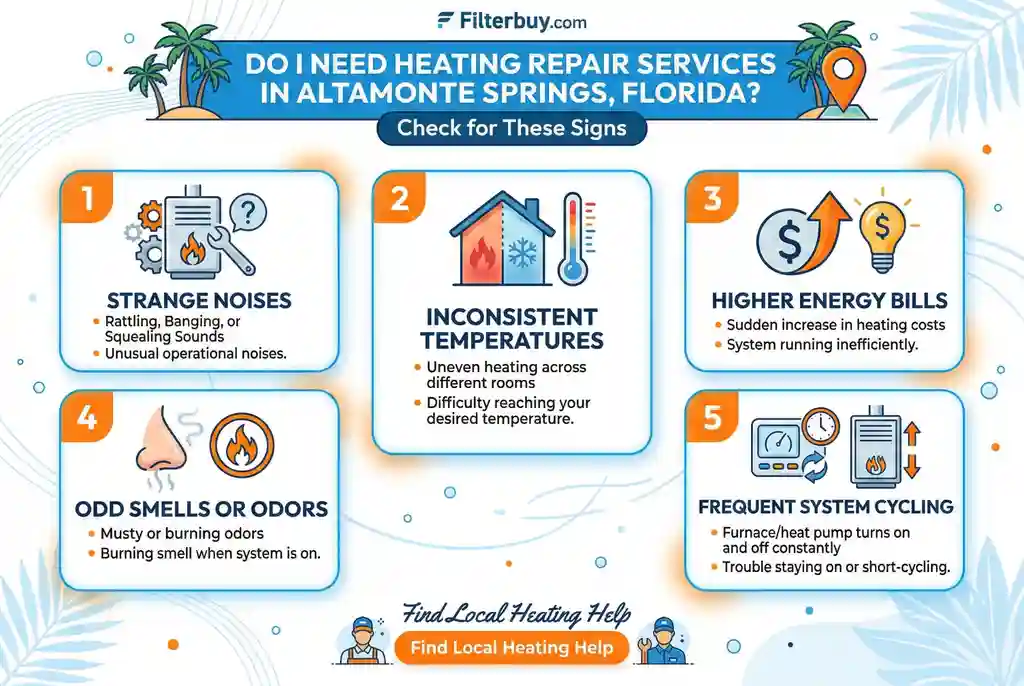
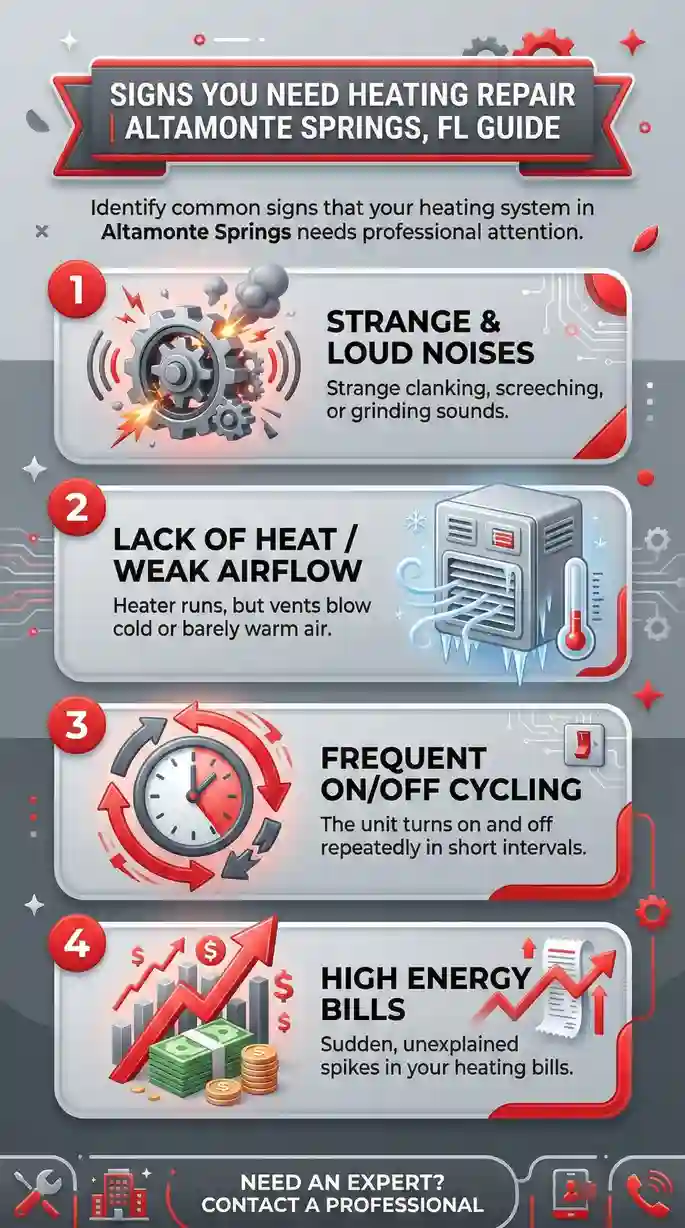
In Do I Need Heating Repair Services in Altamonte Springs Florida?, we explain that the clearest signs you need service usually show up before a full breakdown—longer run times, weak airflow, uneven room temperatures, and humidity that won’t stabilize even when the thermostat looks “right.” Before you assume a major mechanical issue, it’s smart to rule out the most common airflow restriction first with a correctly sized filter, such as a 20x20x1 pleated furnace filter, a dependable 20x22x1 MERV 8 HVAC air filter for consistent everyday performance, or a higher-efficiency 20x25x4 MERV 13 air filter for systems designed for thicker media cabinets. If a fresh filter doesn’t improve airflow or comfort, that’s the point where heating repair becomes the right next step—because catching small issues early is how Altamonte Springs homeowners avoid emergency calls when demand and pricing are at their worst.